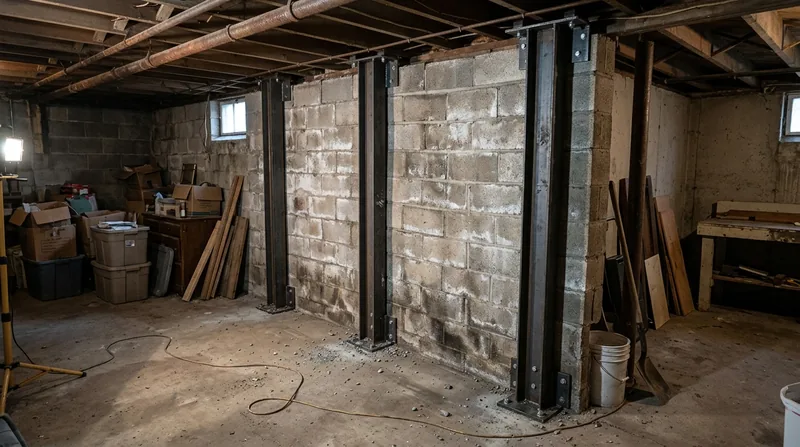




Springfield sits down in the Mad River valley, and the ground under most of this town is glacial clay and till that drains slowly and swells hard every spring. On the older east and north-side streets and around Snyder Park, the 1890s to 1930s brick and frame houses were built with full basements and stone or early block foundations, and after a rough freeze-thaw winter those block walls start to lean inward. Bowing wall repair in Springfield is not the same job as patching a crack: the wall is being pushed from the outside by wet clay, and the fix has to stop the movement before it becomes a structural failure. We specialize in below-grade work only, so we read the wall, the soil pressure, and the drainage as one problem. If you have already noticed a wet basement or a sump pump that runs nonstop, start with a basement waterproofing assessment, because water is usually what is driving the wall.
Why Bowing Walls Show Up So Often in Springfield's Older Brick and Block Basements
The dominant failure mode here is a block or stone wall pushed inward by hydrostatic pressure from saturated glacial clay. The clay holds water instead of shedding it, and the Mad River and local creeks rise fast after heavy storms, so the water table climbs against the footing drain and the wall. Freeze-thaw cycles then open the mortar joints and let more water in, and the wall starts to rotate at the top or bow at mid-height.
- You see horizontal cracks in a block wall, which usually means the wall is bowing, not just settling.
- You see a wall leaning inward at the top, often with a gap opening at the sill plate.
- You see white efflorescence or damp patches that come back after every rain.
- You find doors and windows on that wall sticking, because the frame is being pushed out of square.
- You notice the basement floor heaving or a crack widening along the wall-to-floor joint.
Any one of these is a reason to get the wall looked at before the next spring thaw, not after.
Key info: On a 1920s block foundation near Snyder Park, a horizontal crack at mid-wall with a 1-inch bow is a classic clay-pressure failure. Sealing that crack alone will not stop the wall from moving. The wall needs stabilization, and the water behind it needs somewhere to go.
For the code side, structural foundation repair generally requires a permit in Ohio jurisdictions, and the exact scope and inspection requirements are set locally. Verify with the City of Springfield building department before work starts: City of Springfield, Ohio.
How We Diagnose and Stabilize a Bowing Wall in Springfield
We start by finding out how much the wall has moved and what is pushing it. A straightedge or laser along the wall tells us the bow depth, and a look at the grading, downspouts, and footing drain tells us where the water is coming from. The repair method follows the severity: a slight bow gets carbon fiber straps, a heavier lean gets steel I-beams or wall anchors, and a wall that is also wet gets drainage work so the pressure does not simply return.
- We measure the bow and check the wall for horizontal cracking, step cracking, and movement at the top and bottom.
- We inspect the exterior grade, downspout discharge, and window wells to see how water is reaching the clay behind the wall.
- We recommend the lightest method that will actually hold the wall, and we say plainly when crack sealing alone is enough.
- We install carbon fiber straps, steel I-beams, or wall anchors and tie them into the floor and joist system as needed.
- We correct the water source with drainage or sealing so the repaired wall is not fighting the same pressure next spring.
- We pull the required permit where the jurisdiction requires one and walk the finished work with you.
The goal is a wall that is stable and a basement that stays dry, not a cosmetic patch over a moving wall.
Key info: A 1950s ranch on the west side with a poured wall and a hairline vertical crack usually needs crack repair, not stabilization. A 1930s block wall on the north side with a horizontal crack and a visible bow needs straps or anchors. We tell you which one you have before you spend money.
If the wall is wet as well as bowed, the drainage side is covered on our interior drain tile system page, because relieving the pressure is part of keeping the repair permanent.
Repair Methods We Use and When Each One Fits
Not every bowing wall needs the heaviest system. The right choice depends on how far the wall has moved, whether it is block or poured, and how much clay pressure is behind it. Here is how the methods compare in Springfield conditions.
| Approach | Description | Best for |
|---|---|---|
| Carbon fiber straps | Straps bonded vertically to the inside face of the wall and anchored at the floor and sill. | Light to moderate bow, block walls, minimal excavation. |
| Steel I-beams | Vertical steel beams set against the wall and tied into the floor and joists. | Heavier bow or a wall that has already leaned significantly. |
| Wall anchors | Anchors set in the exterior soil and connected through the wall to an inside plate. | Walls that need to be pulled back or held against high clay pressure. |
| Crack injection plus drainage | Epoxy or polyurethane injection to close the crack, with drainage to relieve pressure. | Cracks that are not yet showing structural movement. |
We match the method to the movement, and we do not sell anchors on a wall that only needs injection and better drainage.
Bowing Wall Repair Cost in Springfield: What to Expect
Pricing for bowing wall repair starts at $600 for the smallest jobs, typically crack injection or a limited strap installation on a wall with minor movement. A full stabilization with carbon fiber straps or steel beams on a typical Springfield block wall runs well above that, and wall anchors on a heavily bowed wall cost more because of the excavation and anchor work. The main cost drivers are the length of wall involved, the bow depth, whether the wall is block or poured, and whether drainage has to be corrected at the same time.
- The number of straps or beams needed scales with wall length, so a 20-foot wall costs more than a 10-foot wall.
- Deeper bows and walls that have rotated at the top need anchors or beams rather than straps.
- Access matters: a finished basement means moving stored items and protecting the floor before we start.
- If the footing drain is failed, correcting it is a separate line item and should be priced clearly.
Get two or three written estimates on the same scope so you are comparing the same repair, not three different guesses. Our full pricing overview shows how the line items break down.
Hiring a Bowing Wall Repair Contractor Near Me in Springfield: What to Check
Bowing wall repair is structural work, so the contractor you hire should be licensed and insured for it and should be able to explain why they chose one method over another. Ask for the license and insurance certificate, ask for local references on block-wall jobs, and ask who pulls the permit. A contractor who cannot answer those questions plainly is not the one to trust with a moving foundation wall.
- Confirm the company is licensed and insured and can provide a certificate on request.
- Get at least two or three estimates and compare the proposed method, not just the total.
- Ask for references from Springfield-area homeowners with the same wall type.
- Confirm who files the permit with the local building department and who meets the inspector.
- Ask whether drainage correction is included or priced separately, and get it in writing.
If a quote sounds too low for the amount of movement you can see, ask what is not included. You can reach us through the contact page to set up a free inspection and a written scope.
We also serve homeowners in Urbana, Xenia, Fairborn, Beavercreek, Enon, and the surrounding Clark County communities, and the same clay and freeze-thaw conditions apply across the region.
Bowing Wall Repair in Springfield: Pricing Guide
| Service | Price | Details |
|---|---|---|
| Crack injection (minor movement) | Starting at $600 | Epoxy or polyurethane injection on a non-structural crack, priced by crack length and access. |
| Carbon fiber strap installation | Starting at $1,200 | Straps bonded to a block wall and anchored at floor and sill, priced per strap and wall length. |
| Steel I-beam stabilization | On estimate | Heavier bow or leaning wall; beam count, wall height, and floor tie-in set the final number. |
| Wall anchor system | On estimate | Exterior anchor excavation and interior plates; soil pressure and bow depth drive the scope. |
| Travel | Included | In Springfield and surrounding areas, no separate call-out or mileage fee. |
| Estimate | Free | Response within 24h at (937) 688-1966, no obligation to book. |
Indicative pricing, the exact cost depends on square footage, finish, and site access. Free personalized estimate within 24h at (937) 688-1966.


