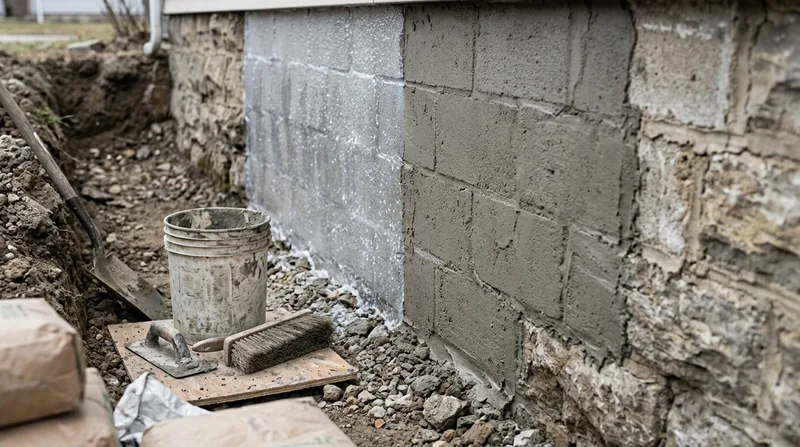




If you own a home in Springfield, the ground under your foundation is working against you. The Mad River valley sits on glacial clay and till that sheds water slowly, so every spring thaw and every heavy storm pushes water toward your walls instead of letting it drain away. The 1890s-1930s houses on the east and north sides and around Snyder Park often have stone or early block foundations with hand-dug cellars that were never designed for today's water loads. West and south-side ranches from the 1940s through the 1960s have poured or block walls that crack as the ground shifts season after season. Foundation Waterproofing in Springfield means matching the fix to what your foundation is actually made of, not selling one system to every house. We handle block, poured, and fieldstone foundations with parging, crack repair, membrane or crystalline treatments, and drainage correction. If you are already seeing water, start with a basement waterproofing assessment so we can trace where it enters.
Why Foundation Waterproofing Matters on Springfield's Clay and Till
Most water problems here are not a mystery. The clay holds moisture, the water table rises after storms, and hydrostatic pressure finds every cold joint, tie hole, and hairline crack. Freeze-thaw cycles do the rest, prying open older masonry a little more each winter. Snowmelt running down the street into low yards makes it worse on the older grid streets.
- Spring rains and Mad River flooding raise the water table fast and load the footing drain.
- Freeze-thaw cycles open cracks in brick, stone, and early block walls.
- Glacial clay soil drains slowly, so water sits against the foundation for days.
- Original weeping tile from the 1920s and 1930s is often collapsed or silted shut.
- Downspouts that dump next to the wall push roof water straight into the problem.
Fixing the drainage and sealing the wall together is what actually stops seepage, and doing only one of the two usually means a callback.
Key info: A 1925 brick house near Snyder Park with a stone foundation and white efflorescence on the wall is showing moisture moving through the masonry, not a single crack. That house needs parging and drainage correction, not a tube of hydraulic cement.
For the official word on what work needs a permit in this jurisdiction, check the City of Springfield building department before any structural or drainage alteration begins.
How We Diagnose and Waterproof a Springfield Foundation
Every job starts below grade with a look at the wall from the inside and the grade from the outside. We map where water enters, check the footing drain if it is accessible, and test the wall for bowing. Then we choose the method that fits the foundation type and the actual pressure, not the one that is easiest to sell.
- We inspect the wall, the cove joint, the tie holes, and the grade around the house.
- We identify whether the source is a crack, a porous wall, or hydrostatic pressure.
- We repair cracks by epoxy or polyurethane injection with injection ports set along the crack.
- We correct drainage with an interior perimeter drain, exterior membrane and dimple board, or a French drain as the site requires.
- We parge and seal stone and brick walls with period-appropriate materials.
- We tie the discharge into a sump basin with a check valve and a discharge line that moves water away from the foundation.
On a 1958 ranch in the west-side neighborhoods, that often means injection first, then a look at whether the original drain tile is still moving water at all.
Key info: A split-level in Enon with water only at the cove joint after heavy rain usually has a footing drain problem, not a wall problem. That is an interior drain tile system conversation, and exterior excavation would be the wrong spend.
Waterproofing Methods We Use on Springfield Foundations
Not every foundation takes the same treatment. Stone and early block walls need breathable, period-appropriate work, while poured walls from the 1950s and later take injection and membrane systems well. The table below shows how we match the approach to the wall.
| Approach | Description | Best for |
|---|---|---|
| Epoxy injection | Structural crack fill that bonds the concrete back together. | Non-moving cracks in poured walls |
| Polyurethane injection | Flexible foam that fills and seals active leaks. | Cracks that move or leak under pressure |
| Parging and crystalline treatment | Surface repair and sealing that works with masonry. | Stone, brick, and early block walls |
| Exterior membrane and dimple board | Waterproof membrane plus a drainage plane against the wall. | Walls being excavated for footing drain work |
| Interior perimeter drain | Drain tile along the inside of the footing into a sump basin. | Hydrostatic pressure and failed footing drains |
We tell you plainly when simple crack sealing is enough and when the pressure means the wall needs drainage work behind it.
Foundation Waterproofing Cost in Springfield: What to Expect
Foundation waterproofing in Springfield starts at $3,500 for a targeted repair with injection and sealing. The number climbs with the length of wall involved, the foundation type, and whether drainage has to be corrected. Stone and rubble foundations take more labor than poured walls because the surface has to be prepped and parged before any treatment will hold.
Access matters too. A wall behind a finished basement, a tight side yard, or a wall that needs excavation all add time and cost. The age of the house and the condition of the original drain tile drive the rest. That is why we give a range only after we have seen the wall, and why two or three estimates from different contractors is the right way to compare. Our full pricing overview breaks down what each method includes.
Choosing a Foundation Waterproofing Contractor Near Springfield
Waterproofing is its own trade, and the contractor who is right for a roof or a driveway is not automatically right for a foundation. Ask what method they plan to use and why, and make sure the answer matches your wall type. A contractor who quotes the same system for a stone cellar and a poured 1960s wall has not looked closely enough.
- Confirm the company is licensed and insured, and ask for a certificate.
- Get two or three written estimates that name the method and the materials.
- Ask for references from Springfield jobs on similar foundation types.
- Ask who pulls the permit if structural repair or drainage alteration is involved.
- Get the warranty terms in writing and confirm whether it transfers.
If anything in the estimate is vague about method or scope, ask again before you sign. You can also contact us with photos of the wall for a straight answer on what you are looking at.
Foundation Waterproofing in Springfield: Pricing Guide
| Service | Price | Details |
|---|---|---|
| Crack injection and sealing | Starting at $3,500 | Covers epoxy or polyurethane injection, surface sealing, and cleanup on accessible poured or block walls |
| Parging and masonry treatment | Starting at $4,200 | Period-appropriate parging and crystalline sealing for stone and early block foundations, priced by wall length |
| Drainage correction with interior drain | Starting at $6,500 | Interior perimeter drain, sump basin, and discharge line, with cost driven by linear feet and access |
| Exterior membrane and footing drain | On estimate | Excavation, membrane, dimple board, and footing drain replacement require an on-site look before pricing |
| Travel | Included | In Springfield and surrounding areas, with no separate call-out or mileage fee |
| Estimate | Free | Response within 24 hours at (937) 688-1966, with no obligation to book |
Indicative pricing, the exact cost depends on square footage, finish, and site access. Free personalized estimate within 24h at (937) 688-1966.


