



Foundation Crack Repair in Springfield: Stop Water Before It Finds the Crack
When you need Foundation Crack Repair in Springfield, the crack you can see in the basement wall is usually the symptom, not the whole story. Springfield sits in the Mad River valley of Clark County, where glacial clay and till shed water slowly and push it against foundation walls every spring. The older east and north-side streets and the Snyder Park area are packed with 1890s-1930s houses on stone or early block foundations, many with hand-dug cellars that have been taking on water for generations. West and south-side ranches and split-levels from the 1940s through the 1960s sit on poured or block walls that crack as the ground shifts with freeze-thaw cycles.
We inspect the crack, identify whether it is a shrinkage crack, a settlement crack, or a sign of hydrostatic pressure, and match the repair method to the cause. If you are also seeing water across the floor, start with our basement waterproofing service so the whole system gets looked at together.
Why Foundation Cracks Open Differently in Springfield's Building Stock
Springfield's foundation cracks follow the housing stock. The 1890s-1930s brick and frame houses on the east and north sides have stone or early block foundations with mortar joints that soften and erode; freeze-thaw cycles open those joints a little more each winter. The 1940s-1960s poured and block walls on the west and south sides crack vertically at shrinkage points or horizontally where the wall is bowing. Newer subdivisions on the edges of town sit on graded glacial till with shallower basements and walkout lots, where hydrostatic pressure after a heavy storm finds the weakest point in the wall.
- Vertical cracks in poured walls usually come from concrete shrinkage and are good candidates for epoxy or polyurethane injection.
- Horizontal cracks and stair-step cracks in block walls point to soil pressure and need a structural look, not just a patch.
- White powder (efflorescence) on the wall means water is moving through the masonry and evaporating on the inside face.
- Water that shows up only after heavy rain or snowmelt usually means the drain tile or footing drain is overwhelmed, not just a cracked wall.
If any of those signs match your basement, the crack repair is only part of the answer and the drainage has to be addressed too.
Key info: A house near Snyder Park with a stone foundation and a vertical crack that seeps only in March is a different repair than a 1965 ranch in Enon with a horizontal crack and a bowing wall. We price and specify them differently.
For the official word on structural repair permits, check with the City of Springfield Building Regulations Division before work begins, since thresholds vary and must be verified locally: City of Springfield, Ohio.
How We Diagnose and Repair a Foundation Crack in Springfield
We start inside the basement, not with a tube of sealer. The technician maps the crack, checks for movement with a level and plumb, looks for efflorescence and moisture patterns, and asks when the water shows up. That tells us whether the crack is dormant or active, and whether the wall is moving. From there we specify the method and explain why.
- We inspect the full wall and the floor-wall joint, not just the visible crack.
- We identify the crack type: shrinkage, settlement, or pressure from saturated glacial clay.
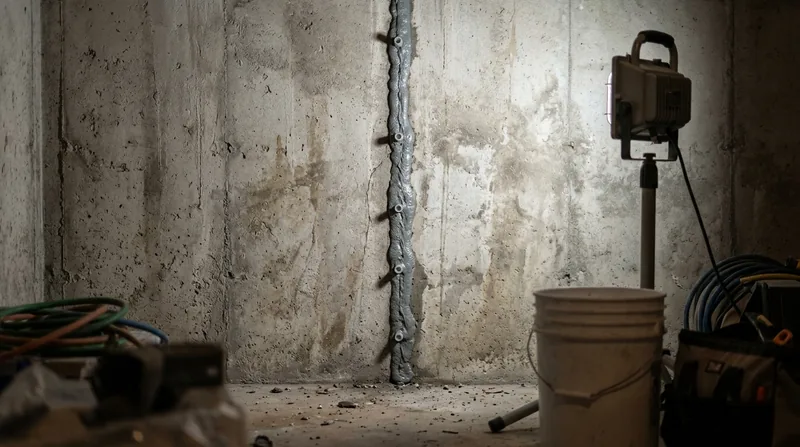
- We set injection ports along the crack and seal the surface for epoxy or polyurethane injection.
- We inject the material under pressure until it fills the full depth of the crack and reaches the exterior face.
- We check for bowing or movement and recommend carbon fiber straps or wall anchors when the wall needs structural support.
- We tell you plainly when the crack is minor and simple sealing is enough, and when the real problem is hydrostatic pressure that needs an interior drain tile system.
Every repair ends with a walkthrough so you know what was done, what to watch, and what the next step is if water returns.
Key info: On a 1950s block ranch in Fairborn, a stair-step crack near the corner was moving, not just leaking. We used carbon fiber straps on that wall and referred the drainage to our interior drain tile system rather than injecting a crack that would reopen.
Repair Methods We Use and When Each One Fits
The right method depends on crack width, wall material, and whether the wall is moving. We do not sell one repair for every crack. Here is how we match method to condition.
| Approach | Description | Best for |
|---|---|---|
| Epoxy injection | Structural epoxy injected under pressure restores the cracked concrete to a solid mass. | Non-moving vertical cracks in poured walls, typically 1/16 to 1/8 inch wide. |
| Polyurethane injection | Flexible foam expands and seals active leaks, staying pliable as the wall moves. | Active leaks, hairline cracks, and cracks that may move with frost and wet clay. |
| Carbon fiber straps | Straps bolted to the wall span the crack and resist inward bowing. | Bowing block walls with horizontal or stair-step cracks. |
| Wall anchors | Anchors driven into stable soil outside pull the wall back toward plumb. | Walls that have moved inward and need realignment, not just sealing. |
| Interior drain tile | Perimeter drain and sump basin relieve hydrostatic pressure at the footing. | Cracks that keep leaking because water is pushing in from saturated clay. |
When the table points to a structural repair, we bring in the bowing wall method rather than injecting a wall that will keep moving: bowing wall repair.
Foundation Crack Repair Cost in Springfield: What to Expect
Most single-crack injection repairs in Springfield start around $450, and that figure covers a standard vertical crack in an accessible poured wall with ports set, material injected, and cleanup. The price moves up with crack length, wall thickness, number of cracks, and access. A stone foundation with soft mortar takes more time than a clean poured wall. A crack that turns out to be a bowing wall needs structural work, and that is priced after an on-site look.
We give a firm number after the inspection, not a phone guess. Getting two or three estimates is smart on any foundation work, and ask each contractor what method they plan to use and why. If the bid says only "crack repair" with no method named, ask for the detail in writing. Our full pricing overview shows how the ranges break down by method.
Foundation Crack Repair Near Me: What to Check Before You Hire in Springfield
Searching for foundation crack repair near me in Springfield turns up plenty of names, so use the same checklist a contractor would. Ask for the license and insurance certificate, ask how they diagnose the crack, and ask what happens if water returns. A firm that only patches cracks and never checks for wall movement is not doing the full job.
- Confirm the company is licensed and insured, and ask for the certificate before work starts.
- Get at least two or three written estimates that name the repair method.
- Ask for local references on jobs similar to yours, especially older stone foundations or bowing block walls.
- Ask who pulls the permit when structural repair or drainage changes require one from the local building department.
- Check HOA rules if you live in a newer subdivision, since some associations restrict exterior work and discharge locations.
If a contractor will not put the method and warranty terms in writing, keep looking. You can reach us through our contact and free estimate page or at (937) 688-1966.
Foundation Crack Repair in Springfield: Pricing Guide
| Service | Price | Details |
|---|---|---|
| Single crack, epoxy or polyurethane injection | Starting at $450 | Includes port setting, injection, and cleanup on one accessible vertical crack in a poured wall. |
| Multiple cracks, same wall | Starting at $750 | Priced per crack after the first; crack length and wall access move the number. |
| Stone or early block foundation crack | On estimate | Soft mortar and irregular joints need an on-site look before a method and price are set. |
| Bowing wall with structural cracks | On estimate | Carbon fiber straps or wall anchors are specified after inspection; movement must be measured first. |
| Travel | Included | In Springfield and surrounding areas, no separate call-out or mileage fee. |
| Estimate | Free | Response within 24h at (937) 688-1966, no obligation to book. |
Indicative pricing, the exact cost depends on square footage, finish, and site access. Free personalized estimate within 24h at (937) 688-1966.


